
What the heck is heart rate variability (HRT), and why should you care?
Heart rate variability is the beat-to-beat variation your heart exhibits every second of your life. We used to believe that a healthy heart thumps like a metronome, but now we know that a strong heart changes dramatically from beat to beat.
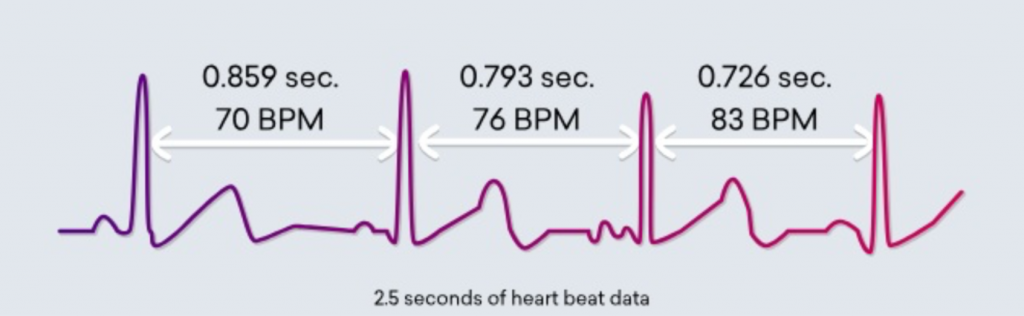
HRV is important because higher HRV is associated with a more flexible and responsive cardiovascular system. It’s also a predictor of greater overall health and longevity.
How does improving HRV help?
When HRV is high, it indicates that both halves of the autonomic nervous system are working together. If we use driving a car as an analogy, it means that the ride (our physiology) is optimal and the gas pedal (fight and flight response) and the brake (relaxation response) are working well as a team.
Alternatively, think of the unpleasant effects when someone drives a car with one foot on the brake and the other on the accelerator. Not fun! The ride is rough, the wear on the car is significant, and energy (in the form of gasoline) is wasted. Unfortunately, this is how many of us deal with daily stress, and it leaves us feeling depleted. Over time, it can lead to illness.
While feelings of anger, frustration, and other negative emotions are normal and will always be a part of our human experience, there’s a price to pay when we don’t have the capacity to emotionally regulate. Dr. James Doty, professor in the Department of Neurosurgery at Stanford University, writes in his book Into the Magic Shop that feelings of love and compassion are associated with an increase in HRV and feelings of anger are associated with a decrease in HRV.
What can I do to improve my HRV?
One way to cultivate a healthier HRV is to regularly practice many of the techniques we’ve discussed over the years in the Resilience for Life blog. These include loving-kindness and other forms of meditation, keeping a gratitude journal, and practicing the Quick Coherence technique from HeartMath, to name a few.
Put your breath to work
Another way to increase HRV is to practice a simple and effective technique called Coherent Breathing. Dr. Robert Brown, Professor of Clinical Medicine at the Columbia University College of Physicians and Surgeons, has done extensive research into the physiological benefits of coherent breathing.
From Dr. Brown’s book, The Healing Power of the Breath:
“When scientists tested people at all possible breathing rates, they found that there is an ideal breath rate for each person, somewhere between three and a half and six breaths per minute for adults using equal time for breathing in and breathing out — a sweet spot where the HRV is maximized and the electrical rhythms of the heart, lungs, and brain become synchronized.”
What this means is that on average, every inhalation and every exhalation take approximately 6 seconds each. It may seem a little awkward or unnatural to breath this way, but the benefits are extraordinary if you stick with it.
We’ve created a five-minute MP3 you can download and use for practice. See if it doesn’t make a difference in how you feel. While breathing through the nose is optimal, if you’re unable to do that comfortably, then breathe through the mouth.
Give your heart a daily Valentine
Practicing for up to 20 minutes a day can help minimize the effects of stress and create greater balance in your nervous system. Even five minutes of it creates a good self-loving break in your day and can increase HRV. As with any mind-body technique, practicing consistently over time is key. Try it for yourself. Let us know how it works for you!
Thanks Jaymie. I have an irregular heart beat but will utilize these exercises. xo
See how you feel when you use it. While this is considered an extremely safe practice, if you have any concerns ask your doctor. Thanks so much for your comment!